English
 Español

Need Help Now? Call Us!
+86-573-8553-5198
Need Help Now? Call Us!
+86-573-8553-5198
Our team proudly offers an on-time guarantee and a 100% customer satisfaction guarantee.
Contact Online


Content
In spiral-wound heat exchangers, the gap between tube layers is not empty space — it is a precisely engineered flow channel that determines how efficiently heat transfers between two fluid streams. Stainless steel spacer strips are the structural elements that define and maintain this channel geometry. Positioned between successive tube wraps, they set the inter-tube spacing, guide the flow of fluids or gases across the heat transfer surface, and prevent tubes from shifting under thermal expansion, pressure cycling, and mechanical vibration.
Without correctly specified spacers, even a well-designed exchanger will underperform. Tubes that contact each other create dead zones where flow stagnates and fouling accumulates. Uncontrolled tube movement induces fretting wear and fatigue cracking at support points. Non-uniform channel widths cause velocity maldistribution — some flow paths accelerate while others slow, reducing the mean heat transfer coefficient and generating hotspots that accelerate local corrosion. The stainless steel spacer strip resolves all of these failure modes simultaneously, functioning as both a structural spacer and a flow-conditioning device within a single compact component.
The primary mechanism by which stainless steel spacer strips improve thermal performance is the controlled increase of convection flow velocity. By setting a precise gap between tube layers, the spacer forces the process fluid through a defined cross-sectional area. For a given volumetric flow rate, a structured flow path produces a higher fluid velocity — and higher velocity directly increases the convective heat transfer coefficient in turbulent and transitional flow regimes.
Beyond simply narrowing the channel, deformed or profiled strip geometries introduce secondary flow effects that further enhance heat transfer. Corrugated, serrated, or wavy profiles break up the thermal boundary layer at the tube wall, creating local mixing that refreshes the fluid in contact with the heat transfer surface more frequently. This boundary layer disruption is particularly valuable in viscous fluid applications — heavy oils, polymer solutions, or process syrups — where a thick insulating layer would otherwise dominate overall thermal resistance. The combined effect can increase the shell-side heat transfer coefficient by 20–40% compared to plain unsupported tube bundles, translating directly into a smaller required heat transfer area for the same thermal duty and reducing exchanger size, weight, and installed cost.
Thermal and mechanical loads in an operating heat exchanger are substantial. Tubes experience differential thermal expansion during startup, shutdown, and load changes. Pressure pulsations from pumps and compressors impose cyclic forces on the tube bundle. Flow-induced vibration — caused by vortex shedding at tube surfaces — generates oscillating stresses that can lead to tube-to-tubesheet joint failure or mid-span fatigue cracking within months of commissioning if not adequately controlled.
Stainless steel spacer strips address these structural risks by providing continuous lateral support along the tube bundle length, eliminating the unsupported span that would otherwise vibrate freely. Shorter unsupported spans raise the natural frequency of the tube above the excitation frequency range of typical process flows, suppressing resonant vibration. The practical outcomes include:
Velocity maldistribution is one of the most underappreciated causes of premature heat exchanger degradation. When flow is unevenly distributed across the tube bundle, regions of high velocity experience accelerated erosion-corrosion while low-velocity zones accumulate fouling deposits. Both effects reduce effective heat transfer area and increase pressure drop over time — shortening the interval between cleaning outages and raising operating costs.
By maintaining a uniform channel geometry across the full tube bundle cross-section, stainless steel spacer strips ensure that fluid velocity remains consistent throughout the exchanger. This uniformity provides measurable service-life benefits:
The selection of stainless steel for spacer strips is a deliberate engineering decision driven by the conditions inside industrial heat exchangers. Process fluids frequently contain chlorides, sulfur compounds, organic acids, or other corrosive species that rapidly attack carbon steel or aluminum. Elevated temperatures further accelerate corrosion kinetics, making material selection critical to achieving the intended service life.
| Grade | Key Properties | Typical Applications |
| 304 / 304L | Good general corrosion resistance, cost-effective | Water, steam, mild chemical service |
| 316 / 316L | Enhanced chloride and pitting resistance (Mo addition) | Seawater, pharmaceutical, food processing |
| 321 | Titanium-stabilized, resists sensitization at high temperatures | High-temperature petrochemical service |
| Duplex 2205 | High strength, superior stress corrosion cracking resistance | Offshore, desalination, high-chloride service |
Across all grades, the fundamental advantage of stainless steel is its self-repairing chromium oxide passive film, which regenerates continuously when mechanically damaged — delivering corrosion protection without any applied coating that could delaminate, chip, or contaminate the process stream. This makes stainless steel spacer strips fully compatible with the strict cleanliness requirements of food, beverage, and pharmaceutical heat exchanger applications.
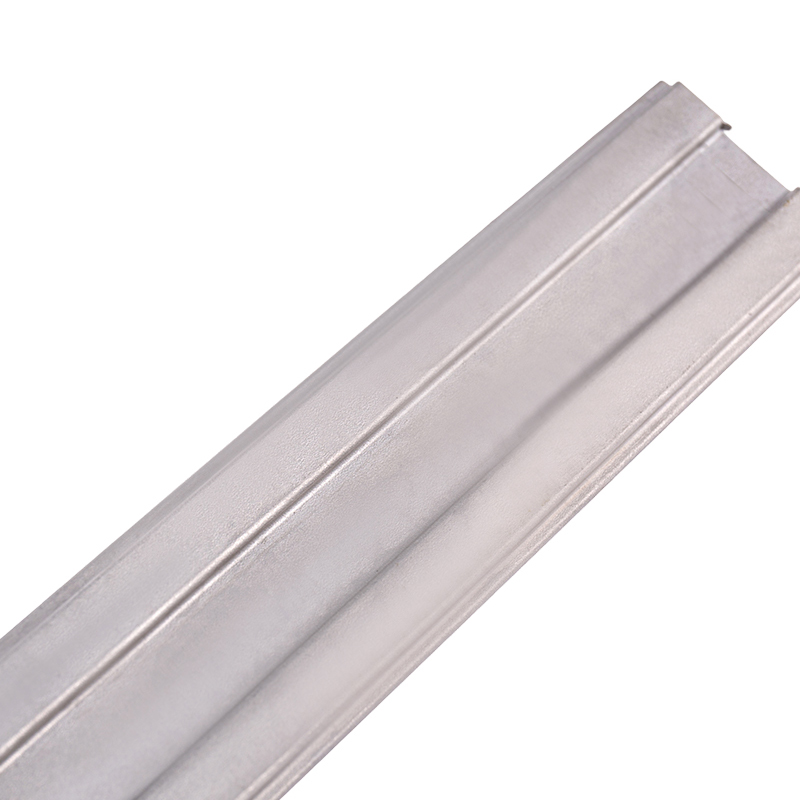
Not all heat exchangers operate under the same conditions, and a single strip profile cannot be optimal across the full range of industrial applications. We offer stainless steel spacer strips in multiple deformed structural geometries, each engineered to match specific flow regimes, fluid viscosities, fouling tendencies, and mechanical loading requirements.
Plain flat strips provide baseline spacing with minimal flow resistance — appropriate for clean, low-viscosity fluids where pressure drop is the primary constraint. Corrugated strips introduce periodic flow deflection that enhances turbulence without a prohibitive pressure drop penalty, making them well-suited for medium-viscosity process fluids in refinery and chemical plant applications. Serrated or notched profiles create jet impingement events at the tube surface, maximizing heat transfer enhancement in highly viscous or thermally resistive fluids. For two-phase applications — steam condensers, reboilers, and refrigerant evaporators — specially profiled strips promote uniform bubble departure and prevent vapor blanketing of the tube surface.
Custom strip profiles, dimensions, and perforation patterns can be produced to drawing for retrofit into existing exchangers or for integration into new equipment designs. The result is a precision component that fits the exchanger's design envelope while delivering the specific thermal-hydraulic and structural performance the application demands — a genuinely customized solution backed by the corrosion resistance and long-term reliability that only high-quality stainless steel can provide.
Products
Contact info.
+86-573-8553-5198
+86-136-1655-8299
+86-573-8553 5198
No. 207, Chuangye Road, Zhapu Town, Pinghu City, Zhejiang Province, China
QR Code
 Forged Stainless Steel Flanges Suppliers