English
 Español

Need Help Now? Call Us!
+86-573-8553-5198
Need Help Now? Call Us!
+86-573-8553-5198
Our team proudly offers an on-time guarantee and a 100% customer satisfaction guarantee.
Contact Online


Content
Heat exchanger spacer strips are precision-engineered components inserted between the wound layers or tube bundles of heat exchangers to maintain consistent spacing, control fluid pathways, and stabilize internal structures under operating loads. Although small in size relative to the overall equipment, these strips play an outsized role in determining how efficiently and reliably a heat exchanger performs over its service life. Without properly designed spacers, tubes can shift under thermal expansion and vibration, flow channels become irregular, and localized wear accelerates — all of which compound into costly downtime and premature equipment failure.
In spiral-wound heat exchangers specifically, the geometry of the wound layers creates a highly compact flow path where even minor deviations in spacing produce disproportionate drops in thermal performance. Heat exchanger spacer strips address this challenge by acting simultaneously as structural supports, flow directors, and vibration dampers — three critical functions delivered by a single, well-designed component. Understanding what these strips do and how to select the right type for a given application is essential for any engineer or procurement professional responsible for heat exchanger performance.
One of the primary functions of stainless steel spacer strips in spiral-wound heat exchangers is the deliberate manipulation of fluid or gas flow to increase convective heat transfer. When fluids travel through an unobstructed annular channel, they tend to develop laminar flow profiles where the boundary layer near the tube wall carries very little thermal energy away from the surface. Spacer strips disrupt this boundary layer, forcing the fluid into turbulent mixing patterns that continuously refresh the hot or cold surface with bulk fluid — dramatically increasing the local heat transfer coefficient.
Beyond inducing turbulence, the physical presence of the strips narrows the effective flow cross-section, which increases flow velocity without requiring higher pump or compressor power input. This velocity increase further enhances the convective heat transfer rate according to well-established Nusselt number correlations. The net result is that a heat exchanger fitted with correctly specified stainless steel spacer strips can achieve substantially higher thermal duty from the same physical footprint — a meaningful advantage in space-constrained industrial installations.
The deformed or profiled surface geometry of many spacer strip designs adds a further dimension to flow optimization. Corrugated, dimpled, or wave-form strip profiles generate secondary flow vortices that sweep fluid laterally across the heat transfer surface, ensuring that neither hot spots nor cold zones develop along the tube length. This results in a more uniform temperature distribution across the entire exchanger, which both maximizes efficiency and reduces thermal stress on tube walls and welds.
Flow-induced vibration is a leading cause of tube failure in shell-and-tube and spiral-wound heat exchangers operating at high fluid velocities or across phase boundaries. When tubes are insufficiently supported, they oscillate at frequencies that can coincide with their natural resonance frequency — a phenomenon known as flow-induced resonance — leading to fatigue cracks at tube-to-tubesheet joints within surprisingly short operating periods. Heat exchanger spacer strips eliminate this failure mode by constraining tube movement and raising the effective natural frequency of the tube bundle above the excitation frequency generated by the flowing process stream.
Stainless steel is the material of choice for this application because its high modulus of elasticity means that even thin strip profiles provide substantial lateral stiffness. A 0.5 mm thick stainless steel spacer strip delivers far greater restraining force per unit weight than an equivalent polymer strip, allowing designers to achieve the required tube fixity with minimal flow obstruction. This combination of stiffness and slenderness is difficult to replicate with other metallic or non-metallic alternatives at an equivalent cost.
The noise reduction benefit that accompanies vibration control is particularly valued in HVAC applications and any installation where the heat exchanger is located near occupied spaces. By mechanically decoupling the tubes from their excitation source and damping the transmission of vibration energy through the tube bundle, stainless steel spacer strips can reduce airborne noise emissions from the exchanger by several decibels — a meaningful improvement that can eliminate the need for costly acoustic enclosures.
Not all heat exchanger applications share the same requirements for flow enhancement, pressure drop tolerance, or mechanical support. This is why stainless steel spacer strips are available in a variety of deformed structural profiles, each optimized for specific operating scenarios. Selecting the appropriate profile is as important as selecting the correct material grade or strip thickness.
| Strip Profile | Key Characteristics | Best Suited For |
| Flat | Minimal flow restriction, simple manufacture | Low-pressure drop gas applications |
| Corrugated / Wave | High turbulence generation, good lateral stiffness | Liquid-liquid and steam condensers |
| Dimpled | Secondary vortex generation, uniform surface contact | High-viscosity fluid applications |
| Lanced / Louvered | Maximum heat transfer enhancement, higher pressure drop | Compact high-performance exchangers |
| Perforated | Allows cross-flow between channels, reduces fouling | Fouling-prone process streams |
Custom deformed structures can also be developed for non-standard heat exchanger geometries or highly specific process requirements, such as two-phase flow regimes where conventional profiles may cause unacceptable maldistribution of vapor and liquid phases across the tube bundle.
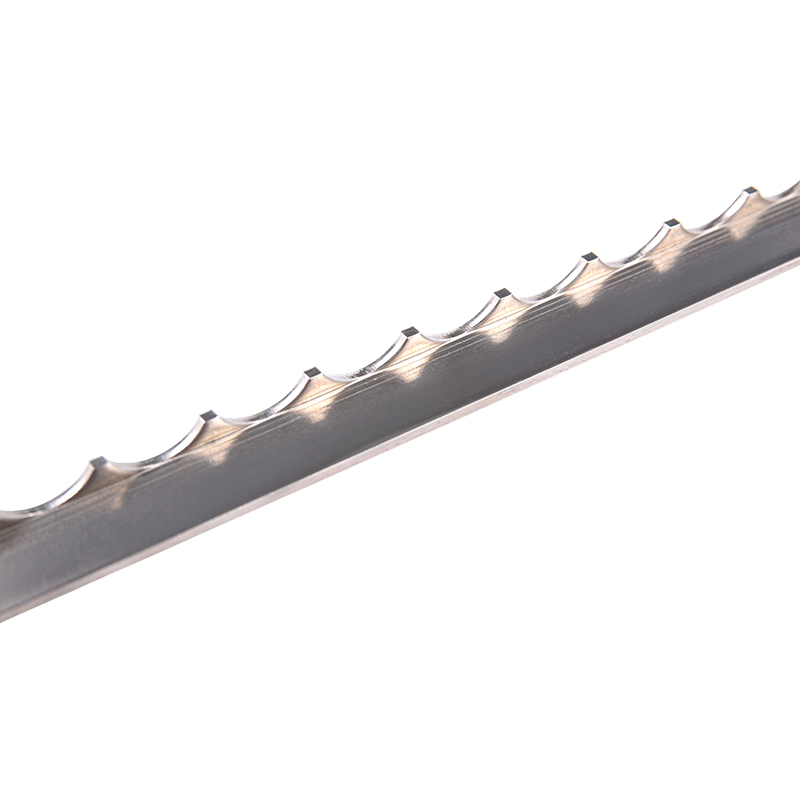
The choice of stainless steel as the base material for heat exchanger spacer strips is driven by a combination of mechanical, thermal, and chemical properties that no common alternative fully replicates. Grades such as 304, 316, and 316L are most frequently specified, with the selection depending on the corrosivity of the process fluid, operating temperature, and chloride content of the environment.
One of the most significant long-term benefits of correctly installed stainless steel spacer strips is the reduction of localized wear caused by uneven flow distribution. When fluid velocity varies significantly across the cross-section of a heat exchanger — a condition called maldistribution — high-velocity zones generate elevated shear stress on tube walls and strip surfaces, while low-velocity zones promote fouling and deposit accumulation. Both conditions accelerate material loss and reduce the effective heat transfer area over time.
By optimizing the flow path geometry, heat exchanger spacer strips enforce a uniform velocity profile that distributes wear evenly across all contact surfaces. This extends the interval between cleaning cycles, reduces the frequency of tube bundle inspections, and ultimately allows the heat exchanger to operate at design duty for a longer continuous period before intervention is required. In applications where the heat exchanger is in a critical process line and unplanned shutdown carries significant production cost, this reliability benefit alone justifies the investment in high-quality stainless steel spacer strips.
Specifying the right heat exchanger spacer strips at the design stage — considering strip profile, stainless steel grade, thickness, and pitch — is a straightforward engineering decision with compounding returns across the operational life of the equipment. Whether the requirement is for a standard corrugated profile in a steam condenser or a custom perforated strip for a fouling-prone refinery application, the combination of precise geometry and high-grade stainless steel delivers consistent, measurable performance improvements that generic or substitute components simply cannot match.
Products
Contact info.
+86-573-8553-5198
+86-136-1655-8299
+86-573-8553 5198
No. 207, Chuangye Road, Zhapu Town, Pinghu City, Zhejiang Province, China
QR Code
 Forged Stainless Steel Flanges Suppliers